Giardini per persone non banali

Autore: giardino

  • La stupidità degli alberi

    La Stupidità degli Alberi

    Immaginate di poter parlare con gli alberi e gli arbusti. Che meraviglia sarebbe scoprire i loro pensieri, le loro storie. Ma immaginate anche di scoprire che queste piante sono, a loro modo, stupide. Sarebbe deludente, vero?

    Gli alberi sono organismi incredibilmente sofisticati. Risolvono problemi complessi: si adattano all’ambiente, resistono alle malattie, collaborano con altre specie. Tuttavia, la loro “intelligenza” è una funzione biologica, non è un pensiero razionale come lo intendiamo noi (per quanto ne sappiamo).

    Spesso, nel desiderio di trovare risposte alle grandi domande della vita, guardiamo alla natura come a un oracolo. Desideriamo che gli alberi o gli animali ci rivelino il senso della vita. Ma questo è un errore. Gli alberi e le piante seguono i principi della fotosintesi e della sopravvivenza, non contemplano misteri esistenziali (per quanto ne sappiamo).

    Questo desiderio di antropomorfizzare la natura può portarci fuori strada. Per esempio, se un ulivo ci svelasse “il senso della vita”, dovremmo credergli?

    La nostra mente, un prodotto dell’evoluzione, è capace di osservare, comprendere e filosofare ben oltre le capacità di qualsiasi pianta.

    E qui entra in gioco la ricerca scientifica. Essa ci insegna a osservare la natura per quello che è, non per quello che speriamo ci dica. La scienza ci permette di comprendere come le piante interagiscono tra loro e con l’ambiente, senza attribuire loro intenzioni o desideri umani.

    In conclusione, mentre esploriamo e ci meravigliamo della complessità della natura, ricordiamoci di mantenere una chiara distinzione tra le nostre capacità umane di ragionamento e di ricerca di senso e la vita biologica della natura. La vera saggezza sta nel riconoscere e rispettare queste differenze, imparando dalla natura senza imporre su di essa le nostre narrazioni.

  • Trees are political and blasphemous

    The space trees occupy is a political space, and every space where a tree stands is a space that is subtracted from the technical needs of our civilization, and of course our economy. The complexity of an ecosystems mirrors a lost biological and geological complexity, much like how glass can evoke the memory of crystal, to quote Italo Calvino, or how rich, stratified soil possesses a harmony that an engineered embankment will never match.

    Nature is perceived through maintenance

    Maintenance has rules that run throughout all the fields that need said maintenance. Maintenance, as a ritual practice and a manifestation of the technical landscape, has profoundly changed our perception of nature. We often assume that natural things simply exist, wether we make a decision or not, but no aspect of our human experience escapes this influenc of tech-and-budget-driven maintenance. Ecosystems, rivers, forests, prairies, rocks, air, the temperatures we experience, our bodies and minds, our interaction with intangible substances, both indoor and outdoor environments, sounds and noises, the disappearance of silence and the acceptance of a discordant mechanical background as a part of necessary silence, the acceptance of chaos that represents not vitality but neglect and lifelessness.

    Grazie per aver letto Garden and Landscape! Iscriviti gratuitamente per ricevere nuovi post e per supportare il mio lavoro.

    Behind each of these things, far in the distance there she blows: maintenance.

    Spaces are artifacts

    We, dwelling in our Western world, have come to accept artificiality as a desirable and natural state of space. A concrete-sealed piazza, if left to nature, is easier to manage than a simple meadow with tall grass and flowers, at least in our minds: this space, reclaimed to concrete, taken over by shrubs, contains a technical element that makes it logical within the framework of maintenance. A paved area functions like a large pipeline system, complete with inspection points: while it is impossible to prevent nature from taking its course (like grass growing), it is possible to intervene and regain control. This reflects a ritualistic, cult-like, dogmatic mindset that looks to the annihilation of all Nature as salvation.

    Technical and Bureaucratic Space

    Technical space isn’t necessarily physical; it can also be bureaucratic. It represents a landscape management technique that transcends natural phenomena, connected to them only by regulations. This is the lens through which we interpret and recognize the world: technical space is certain and measurable, and certainly it’s dogmatic, because it needs no justification. On the contrary it exists within its predetermined use, the genius loci, soul of a sacred practical sense: infrastructure and road transport, cable and pit, riverbank and cage.

    The Sacred Pragmatic

    What we consider pragmatic it’s actually sacred, feeding the sensation of a machine in motion, even if it actually fosters widespread, violent, and nervous traffic congestion. This defines the ethics and the aesthetics of public and private spaces, of physical and mental spaces, declaring a new form of beauty. Pragmatic here merely means easily reproducible. Traditional beauty can only be wistfully acknowledged; its beauty is insufficient to ensure its existence. Futuristic utopia has become present topology, the technological dream with no end outside itself is an ouroboros sustained by its body of economic debts, social, cultural, and ecological credits.

    Infrastructure is a god

    Infrastructure is an aggressively needy and fragile entity, demanding constant care. Plant and animal lives, including human ones, are sacrificed to it. Infrastructure, married to industry, requires no reasons and provides none. Industry, as a concept, needs to expand and grow, and it does. Infrastructure adapts as long as industry demands and produces, massively, without diversification, through emulation and reproducibility.

    Technology: a dream

    The promise of moving quickly and speeding up tasks—the great technological dream of freeing humanity from toil—creates new burdens, externalizes, and demands. Travel time has not decreased compared to 200 years ago; it remains the same, with distances increasing. The voracious infrastructure demands time and space, the only realities we inhabit; resources are limited: we cannot create new space, and we cannot create new time. The landscape thus remains residual, nature merely a leftover. All is existing is just a standard.

    Restoring Time and Space

    Can we transform ancient materials into new, creative, life-giving art, as medieval architecture did? Could the erosion of cultural and landscape capital be adapted to the Now, re-evaluated with new languages and harmonies? Restoring time and space by reusing the energies and materials that make up nature, like ancient artifacts and column used instead of bricks in a Romanesque church.

    It is difficult to justify Nature, it’s easier to for us if it gets eliminated.

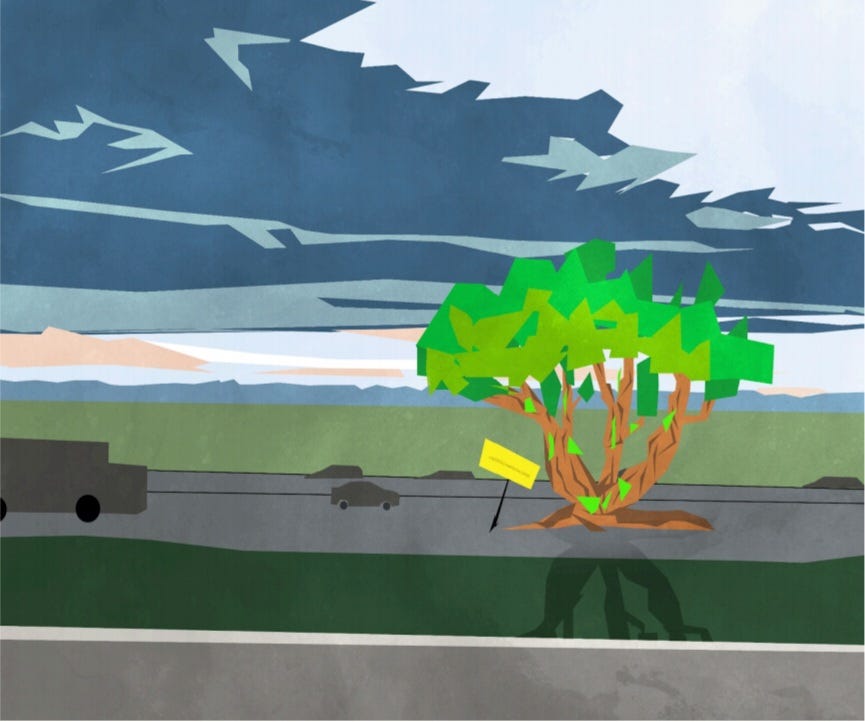
    So, what is the purpose of that tree?
    Grazie per aver letto Garden and Landscape! Iscriviti gratuitamente per ricevere nuovi post e per supportare il mio lavoro.

  • Boring things, living things

    Wandering through Istanbul (something that had never happened to me), one can come across a very characteristic neighborhood with wooden houses. Inside one of these houses in the Çukur Cuma district, you’ll find the Museum of Innocence, conceived, founded, and managed by the Istanbulite writer Orhan Pamuk. It collects objects that have a story and displays them. There is also a beautiful novel with the same name.

    For a period of my life, I found gardens unbearable. This period came at the end of another long period during which I was indifferent to them. In reality, I later realized that it wasn’t exactly the gardens themselves but rather the associations they represented. As a teenager, it seemed to me that they only served as a pretext for long and personal wars, from Paradise Lost to Vaux-le-Vicomte, all the way to the most ordinary gardens… I imagined the garden as a locus amoenus and the gardener as Samwise Gamgee, while often I saw people who, in order not to show their lack of skills, were willing to let every plant die. This was unbearable to me: I have a cousin allergic to pollen—I’m a doctor; I’ve played Assassin’s Creed—I’m a historian; I love my grandmother’s Bougainvillea, so I must be an agronomist.

    Thanks for reading Garden and Landscape! Subscribe for free to receive new posts and support my work.

    I’m exaggerating, but it’s such a common complaint that it’s hard to escape, and as a teenager, it disgusted me so much that it led me to reject this environment, which has always been fundamental in my family. But the dissent I expressed was important to me: the one against culture as an exercise of power, the culture that excludes. I think this is one of the reasons why among the many activities, gardening and garden culture in general inspire a bit of fear, a bit of disgust, a bit of boredom: “no, I don’t understand anything about plants.”

    Because gardens in Italy must struggle, they are in danger. All the things that have been said from the post-war period to today, I’ll make them inaccessible, building walls of concepts and experience, as if art were not also made by those who approach an ancient subject with fresh eyes, as if everything possible has already been given and said.

    I am usually quite liberal when it comes to gardens. I believe that a supposed ugliness or a lack of care, are not what ruins them the most, but rather the intention and the love they have experienced… whether there is a consequentiality or not is another matter: as long as a garden makes you want to stay outside, to hide, to read and eat, to kiss, to play, then I think that garden, even if made only of Bergenia and Begonia, needs to exist, it has the right to claim its strength. It reminds me of the Museum of Innocence I mentioned earlier: a place of true stories, not idols.

    Just like in Paradise in Eden.

    Eden is a steppe, and in the middle was the most beautiful Garden of all, created by the best Gardener specifically for us, whom we were supposed to care for; we couldn’t manage it, we preferred to take leaves to cover ourselves and hide: we no longer saw love in the Garden, only duty. It had become an uninhabitable place for us. The good thing is that now the task is to find it again, to recreate the Garden, experimenting and, above all, following desires.

    “Scintilla celeste, e impulso sovrumano vuolsi a fare un sommo poeta”1

    Gardens often reflect who we are, much like homes: houses filled with books are beautiful, but if there’s never a murmur, never anything unexpected, never a scream or a buzzing bee, mold quickly takes over.

    1

    “A heavenly spark and a superhuman impulse are needed to a supreme poet.” Giacomo Leopardi, Letter to Madame de Staël, 1816