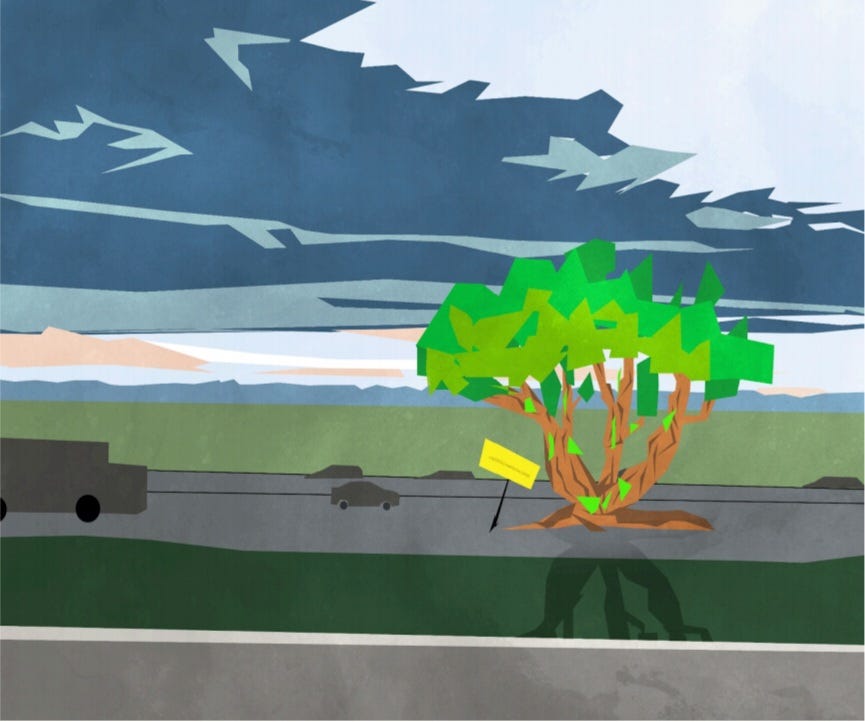
The space trees occupy is a political space, and every space where a tree stands is a space that is subtracted from the technical needs of our civilization, and of course our economy. The complexity of an ecosystems mirrors a lost biological and geological complexity, much like how glass can evoke the memory of crystal, to quote Italo Calvino, or how rich, stratified soil possesses a harmony that an engineered embankment will never match.
Nature is perceived through maintenance
Maintenance has rules that run throughout all the fields that need said maintenance. Maintenance, as a ritual practice and a manifestation of the technical landscape, has profoundly changed our perception of nature. We often assume that natural things simply exist, wether we make a decision or not, but no aspect of our human experience escapes this influenc of tech-and-budget-driven maintenance. Ecosystems, rivers, forests, prairies, rocks, air, the temperatures we experience, our bodies and minds, our interaction with intangible substances, both indoor and outdoor environments, sounds and noises, the disappearance of silence and the acceptance of a discordant mechanical background as a part of necessary silence, the acceptance of chaos that represents not vitality but neglect and lifelessness.
Behind each of these things, far in the distance there she blows: maintenance.
Spaces are artifacts
We, dwelling in our Western world, have come to accept artificiality as a desirable and natural state of space. A concrete-sealed piazza, if left to nature, is easier to manage than a simple meadow with tall grass and flowers, at least in our minds: this space, reclaimed to concrete, taken over by shrubs, contains a technical element that makes it logical within the framework of maintenance. A paved area functions like a large pipeline system, complete with inspection points: while it is impossible to prevent nature from taking its course (like grass growing), it is possible to intervene and regain control. This reflects a ritualistic, cult-like, dogmatic mindset that looks to the annihilation of all Nature as salvation.
Technical and Bureaucratic Space
Technical space isn’t necessarily physical; it can also be bureaucratic. It represents a landscape management technique that transcends natural phenomena, connected to them only by regulations. This is the lens through which we interpret and recognize the world: technical space is certain and measurable, and certainly it’s dogmatic, because it needs no justification. On the contrary it exists within its predetermined use, the genius loci, soul of a sacred practical sense: infrastructure and road transport, cable and pit, riverbank and cage.
The Sacred Pragmatic
What we consider pragmatic it’s actually sacred, feeding the sensation of a machine in motion, even if it actually fosters widespread, violent, and nervous traffic congestion. This defines the ethics and the aesthetics of public and private spaces, of physical and mental spaces, declaring a new form of beauty. Pragmatic here merely means easily reproducible. Traditional beauty can only be wistfully acknowledged; its beauty is insufficient to ensure its existence. Futuristic utopia has become present topology, the technological dream with no end outside itself is an ouroboros sustained by its body of economic debts, social, cultural, and ecological credits.
Infrastructure is a god
Infrastructure is an aggressively needy and fragile entity, demanding constant care. Plant and animal lives, including human ones, are sacrificed to it. Infrastructure, married to industry, requires no reasons and provides none. Industry, as a concept, needs to expand and grow, and it does. Infrastructure adapts as long as industry demands and produces, massively, without diversification, through emulation and reproducibility.
Technology: a dream
The promise of moving quickly and speeding up tasks—the great technological dream of freeing humanity from toil—creates new burdens, externalizes, and demands. Travel time has not decreased compared to 200 years ago; it remains the same, with distances increasing. The voracious infrastructure demands time and space, the only realities we inhabit; resources are limited: we cannot create new space, and we cannot create new time. The landscape thus remains residual, nature merely a leftover. All is existing is just a standard.
Restoring Time and Space
Can we transform ancient materials into new, creative, life-giving art, as medieval architecture did? Could the erosion of cultural and landscape capital be adapted to the Now, re-evaluated with new languages and harmonies? Restoring time and space by reusing the energies and materials that make up nature, like ancient artifacts and column used instead of bricks in a Romanesque church.
It is difficult to justify Nature, it’s easier to for us if it gets eliminated.
So, what is the purpose of that tree?
Lascia un commento