Months ago, while talking with a philosophy student about Science and Metaphysics, he made an argument about a sort of pantheism and I asked something about quality and quantity – like “so god is only the whole of natural things?”. He suddenly looked scared and said “that’s too medieval and also no.”
What I find curious is that the more I get entangled with ecology, the more I think in that way.
Otherwise I should think that a fungus is God.
Which is nice if that’s your faith, but feels quite lazy if you’re a secularised westerner.
As a person invested in observing gardens and landscapes in relation to the people that inhabit them, Ecology is interesting as a theoretical, philosophical subject for many reasons, I think.
It crosses aesthetics in landscape studies and can go into moral speculation from that point.
Ecology is a basically infinite closed system, therefore virtually inexplorable in its entirety, which is why many see it as a good substitute to theology by our contemporary standards: it’s measurable but it’s complex: very, very complex.
Also physicysts started to dig in it, of course.
You see that in many scientists that touched complex systems, because it’s the complex system par excellence.
So philosophers can feel like they’re scientists and scientists can feel like they’re philosopers and all of them can add a cup of mysticism from time to time, not on an academic paper by the way, but surely in the way they understand and narrate it.
It is enough that you never arrive at a finalistic vision, to make them happy.
It’s not uncommon to hear people claiming an overlapping of what we know about physics and ecology with buddhism (at least in western buddhism).
This can be because of a lack of revealed truth, that what we know is never by revelation, because that cannot be demonstrated, of course. This is also for the absence of finalism in both domains. Everything has come from observation, just like the Four nobles Truths.
You’ll therefore read about famous people saying something like “Buddhism is science” (I don’t know – Richard Gere? I heard saying that in interviews2). I think I can safely assume that this thread, if explained in these terms, could be accepted by a fair amount of people in the West.
This by the way put a barrier between a medieval way of thinking and ours. At least I have to accept that while reading Eckhart I really struggle in accepting finalism as an argument, and could that be connected to my ecological studies, I fear. I have to work around with causality in some way.
So I must conclude that I find nature and ecology complex and godless. I don’t look for the purpose of a forest canopy to find metaphors for, let’s say, my faith. The more nature shows itself as sense-less, the more I understand revelation as a concept. A handful of Hebrew language lessons from a dear and knowledgeable friend came in help, too, in perceiving that the God that reveals its name on the Sinai is not something that one can easily talk about. It’s not a being, it’s not a spirit, it’s not a something. It’s beyond, before and after whatever things.
And here I stop.
But the revelation that such a THING is concerned by our existence, is already too much, and that can only come from revelation, never from observation. It’s unsettling and devastating. Of course reality itself is unsettling and enormous, it can make you lose reason, but it’s not as much that THING, that Name. That’s revelation.
In nature I find connections and correspondences, which aren’t true because I find them, but I can see them nevertheless, and that seeing is what revelation seems to be about in the end.
Now, if you face the problem with finalism as a person that has some kind o faith in that Being: you try to apply it to your daily life: “the skies are proclaiming the glory of God THEREFORE we must do something about that”.
In ecology you have primarily observation, only after, when morals and human need come in, you do something with what you have discovered. It’s something else from an ecological knowledge.
That HaShem seats on the storm3, that his name is Sprout4, can be that everything’s a reflection of God’s relationship with the world (“love”?), but you won’t find it in a mere natural fact, just like you won’t find it in the fact that there is a trophic system. Only in things that you can understand, you could find a sense of this relationship, because creation, as a whole, is a narration, and of course any narration brings in itself the message and the reality of its narrator, and cannot be divided. A comma in “Crime and Punishment” isn’t Dostoevksij, but at the same time he poured himself in it at that moment, and his whole corpus says something about him.
For what we usually call God, of course, no limitation whatsoever can occur, we’re not talking about a demiurge. Because he is “the father of orphans, the champion of widows”5. There’s something interesting on this matter about the scattering of the soul in being active in Eckhart’s second sermon, but I don’t think I’m able to explore it now.
So why do I see a link between medieval thinking and ecological studies?
Because as far as I understood (and that could be where I’m wrong about medieval logic), you don’t need to demonstrate that God exists by showing something happening in nature, it’s quite the opposite: if something happens in nature is because of God, whether that’s visible or not, because the causal chain began outside of the physical world, not inside of it. Otherwise, you enter the domain of recursive causes, of circular reasoning, of a perpetual motion that is not thinkable in our universe.
Ecology, just like physics, can even explain itself, as a chain of physical, chemicals and biological events, but can it go into metaphysics, beyond its origins without disappearing into other domains?
I’ll use as an example, a Ghostbusters marathon on TV during the lockdown. Since I’m relegated on a sofa I watched it and thought about Gozer the Gozerian, the fictitious mesopotamian god appearing at the end of the movie. While we’re convinced that spirits and gods see God in its reality, maybe they’re just greater beings, quantitatively speaking, therefore they experience the same reality as we do. Which means that you can’t find God, you cannot prove anything about God unless it comes from a revelation.
Somewhere in the book on the Experience of God David Bentley Hart states that Thomas Aquinas said that an infinite world as Aristotle said was logical and that only by faith he rejected it, and that even the world was infinite, this didn’t affect God’s status. This reminds me of the idea of an eternal recurrence of Big Bangs, of how the way natural processes in our ecosystems happen are used as a proof of God’s absence.
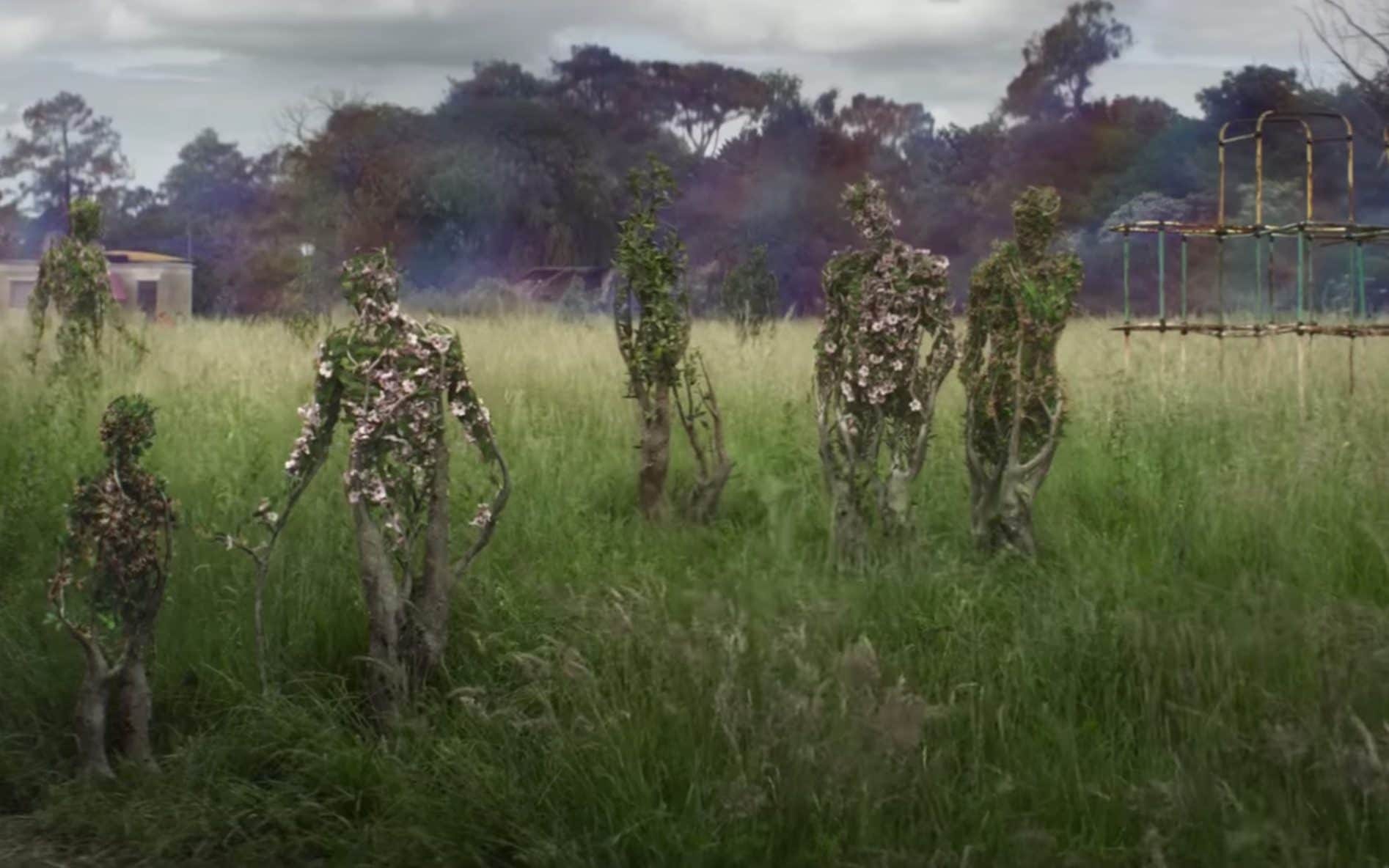
Like in the movie “Annihilation”: how can that disprove anything about anything? Any unexplicable fact, any miracle, is just “natura ignota”.
I’m not a philosopher, I’m not trained in logical thinking or anything, it’s just something that goes behind the curtain of my mind, but I feel like this is quite a simpleton’s way of thinking and hope it can be fruitful or even interesting, just to spend some time.
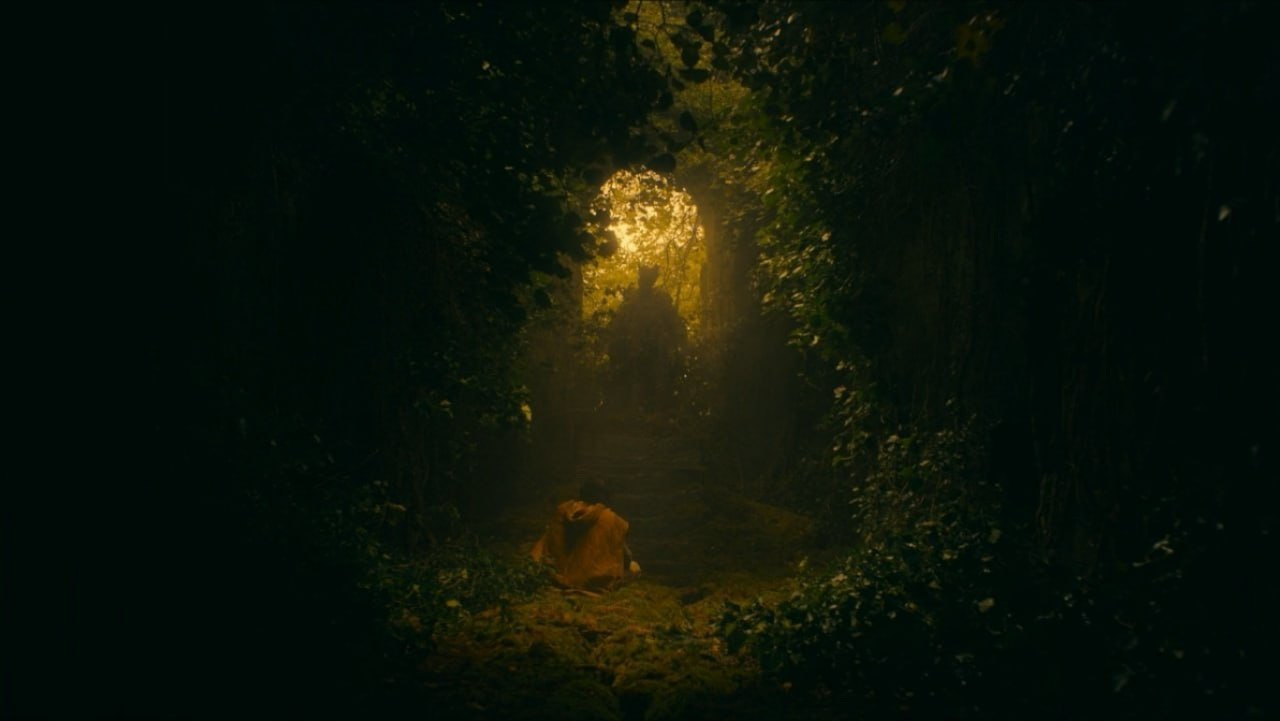
From The Green Knight by David Lowery, 2021
This is a conversation on Buddhism and Physics
Psalm 29:10
Psalm 72:17
Psalm 68:6
From Annihilation by Alex Garland, 2018
Lascia un commento