Caterina had started to clean it after discovering that it belonged to her aunt and that none of the relatives ever went there. She could come by occasionally to take a look: the garden had made her realize that if it had survived on its own for a long time, it could also do so with only sporadic attention. She had made an arrangement with the neighbors, an elderly couple of retired butchers, who, when they saw how she had brought that place back to life, became enthusiastic and offered to lend a hand, to water it; it was easy for them because they had a ladder that led directly there from their house.
It was a little garden that had been abandoned for centuries, or so everyone said, for about twenty years: a rectangle that takes less than three minutes to walk back and forth.
Abandoned after A***’s death, it had saved the skeleton of a rich British cultivation, according to those who say that A*** was a lover of horticulture, passed down from a Welsh love who had lived in the village for a few years – they say – because of a crime committed in his home country. A*** started again and left behind a garden begun together and many sighs, which did not last long because A*** was certainly a sensitive woman, but cheerful and pragmatic and after shedding the crusts from her heart, she fell in love with another man who became her husband. There are no whispered rumors about him, only certainty of his intelligence and sincerity of feelings: he never opposed his wife’s gardening practice, which she had explained the origin of her passion for.
The camellia garden was a tribute to the tradition of the Bourbon volcanoes, which hosted them in collections since the eighteenth century, often together with hydrangeas. – it was also an Englishman who brought them, for the first time, to Caserta.
Protected from the Etna sun by the shade of the little palaces, at first the rich variety of blooms, perennial herbs, and obviously seasonal plants were lost. What was saved was a pool of plants that loved slightly more acidic soils, such as camellias and hydrangeas, as well as heather cushions; on the other side, there was a collection of tropical plants: succulents, euphorbias, a couple of prickly pears, and a dracaena.
As mentioned before, partly due to the shade, partly due to the wilderness that had covered the plants, the garden was preserved from the scorching sun and rare frosts.
It was difficult for Caterina to start cleaning it. It wasn’t just weeds – a forest of tree-of-heaven, locusts, and laurels had grown up, three or four meters high, with thick roots and slender trunks as one climbed higher.
She was initially tempted to leave some of the small trees, after all both the ailanthus and robinia are beautiful, albeit invasive, but then she remembered the white flower she had seen sprout from the wall in winter, that time she had come to snoop around the village, before knowing she could enter the enclosure that she would later restore to a garden. Observing that etiolated plant spitting out a solitary branch among the alien ones, she wondered how powerful the desire of the one who first placed that camellia there must have been, a poem with sap that endures over time and beyond adversity.
She had then discovered the pond, and a path of white stones and cement that ended against the yellow-pink wall, and had cleaned up the plants, pruned them to rejuvenate and give them strength, to make them bloom more compact and vigorous in the following years. She had asked for advice from nurseries, gardeners and some manuals from the 1930s.
Now that the garden has returned to being lush, young and old, flowering and with many spaces between one plant and another, she doesn’t know how she will change it again, in the meantime she comes here, leans against the low wall and reads.
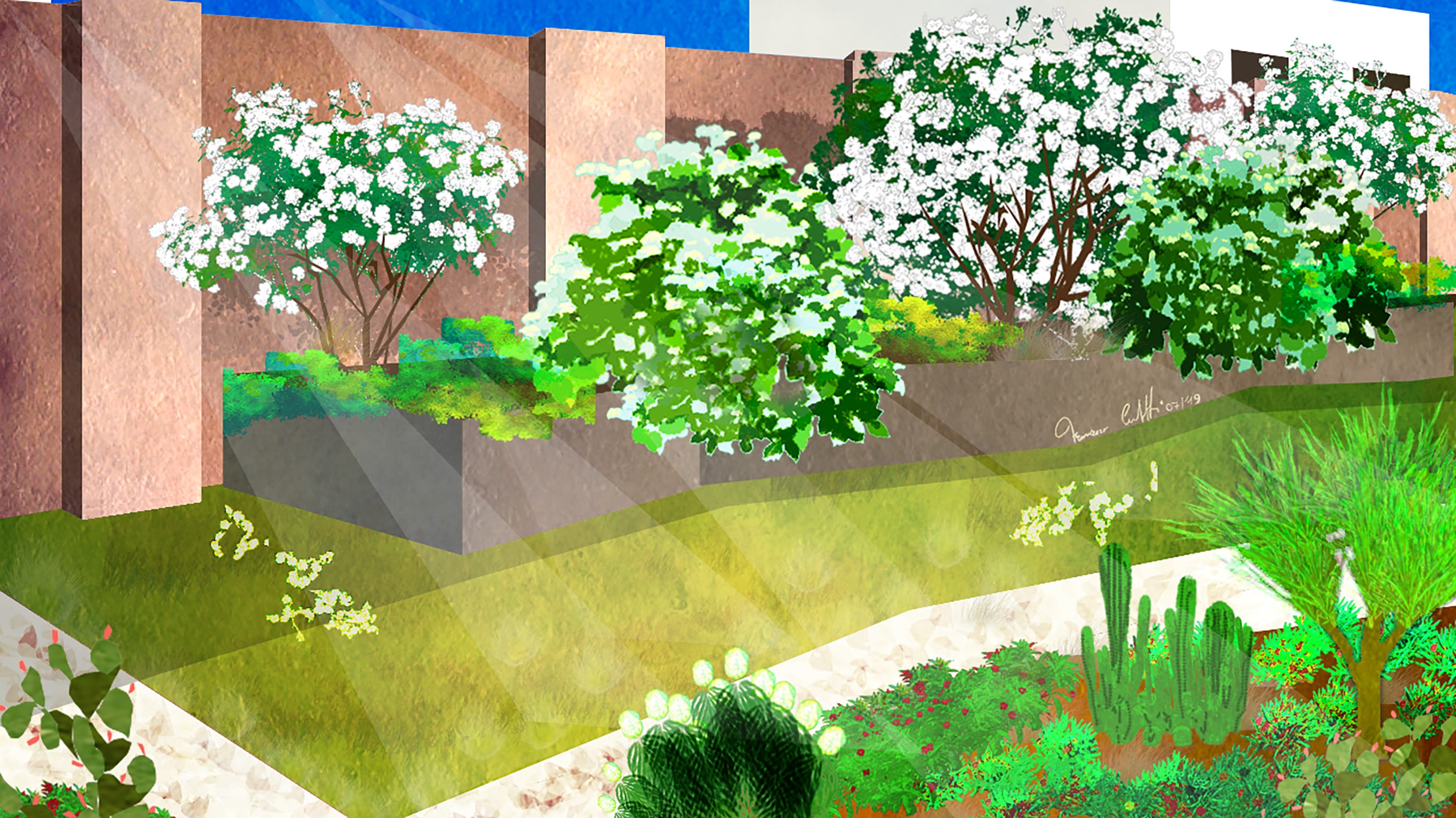
The plants in the garden are:
in the basin:
Calluna vulgaris
Camellia cuspidata × saluenensis
Hydrangea macrophylla
the tropical display:
Carpobrotus edulis
Dracaena draco
Euphorbia ingens
Euphorbia characias
Euphorbia milii
Opuntia ficus-indica
Lascia un commento