There is something very strange about our relationship with image creation now, in this period when generative artificial intelligence is capturing our attention.
As Umberto Eco used to say, there are apocalyptic and integrated individuals in every era and every aspect of life. Although I often lean toward the apocalyptic side, I don’t find myself being so with these new tools. “I explain myself worse,” as Italian Marxist popularizer Gio Pizzi says.
I’m not apocalyptic when it comes to philosophical issues: all the various “where will we end up” or “people won’t be able to do this or that anymore” arguments. I don’t think I’m right; it’s just that I don’t feel inclined to be apocalyptic here. Obviously, in this, I’m part of the problem because I use these tools. What do I use them for? To format texts, to clean up things I’ve already done, to spot errors here and there, check grammar and spelling, to transcribe audio into words, to reorganize documents, and — I realize this is unpleasant — to help me write emails I don’t feel like writing.
But there’s a fundamental point: I don’t trust these tools. I remember when people around me started talking about ChatGPT, they were disappointed because they hoped they could delegate all their work to this tool. But I quickly realized I couldn’t hand over the tasks I most wanted to delegate to this so-called generative artificial intelligence, like filling out Excel sheets, resolving minutiae, doing boring jobs, or getting rid of nuisances so I could focus on what interests me most. It became clear to me from the start that the utility of the tool lies in the person’s ability to discern what they’re reading. So first and foremost, treat it as you would treat someone you meet on the street: “Does this person really know what they’re saying? Who are they, what are they telling me, can I trust them?”
Sure, I’ve also used it to translate texts in languages I don’t know, where automatic online translation wasn’t effective. I’ve used it when I had to complete tasks in a short amount of time.
In short, I’ve used it, and I sometimes still do, and it always leaves me with a sense of guilt for using a tool whose entire reason for existence seems to be intellectual property theft for profit, and which also exists thanks to the use of natural resources.
Coming from me, it’s even worse: I’m a landscape architect, so I know what it entails (part of me also thinks the same argument applies to all the technological devices I use and fuel consumption, etc.).
I also try to pay attention to the tools coming out, like when DeepSeek or Qwen entered the scene, claiming (rightfully?) to have less ecological and energy impact.
I’m not trying to absolve my conscience this way; I’m trying to analyze the fact that this tool exists and that it seems impossible to remove it from our lives. I know for certain that virtually all design firms use these tools. There are clearly different ways to use artificial intelligence: I think, for example, about how Blender has silently integrated it into functionalities like denoising rendered images. I think about autocorrect tools.
In short: tools. Like washing machines, dishwashers, or the little robot that cleans the house.
I’ll admit that in the first few months, almost three years ago now, I was fascinated by image generation: I had no idea how it worked, and that doesn’t reflect well on my intellectual abilities, because it’s fairly obvious, once you think about it, that these resources must come from somewhere. There was also a bit of indifference in the sense that I’ve never had issues with the concept of piracy when it involves large economic and financial entities, big corporations. I remember once, when I was younger, having a discussion with a friend overseas who told me we shouldn’t watch films by controversial authors or buy their books so as not to contribute to their funding. We ended up debating whether pirating those same films might actually not be a problem, or even something to take pleasure in since it harms them. Childish chatter: of course I never pirated anything in my life, I would never even dare to do it.
The problem arose when I realized that what was being targeted, sucked into this vortex of authorless image generation, actually does have an author — and that author receives no credit.
The troll response on Twitter is that there’s nothing different from training oneself to copy a style, and that a style can’t be protected by copyright. But we’re fully aware that this is nonsense. There’s a difference between me learning to draw with effort (I shall very unelegantly advertise I small piece I wrote on effort and poetry)
and dumping terabytes of images into a data grinder that spits out soulless pictures.
I’d say the same goes for generating text.
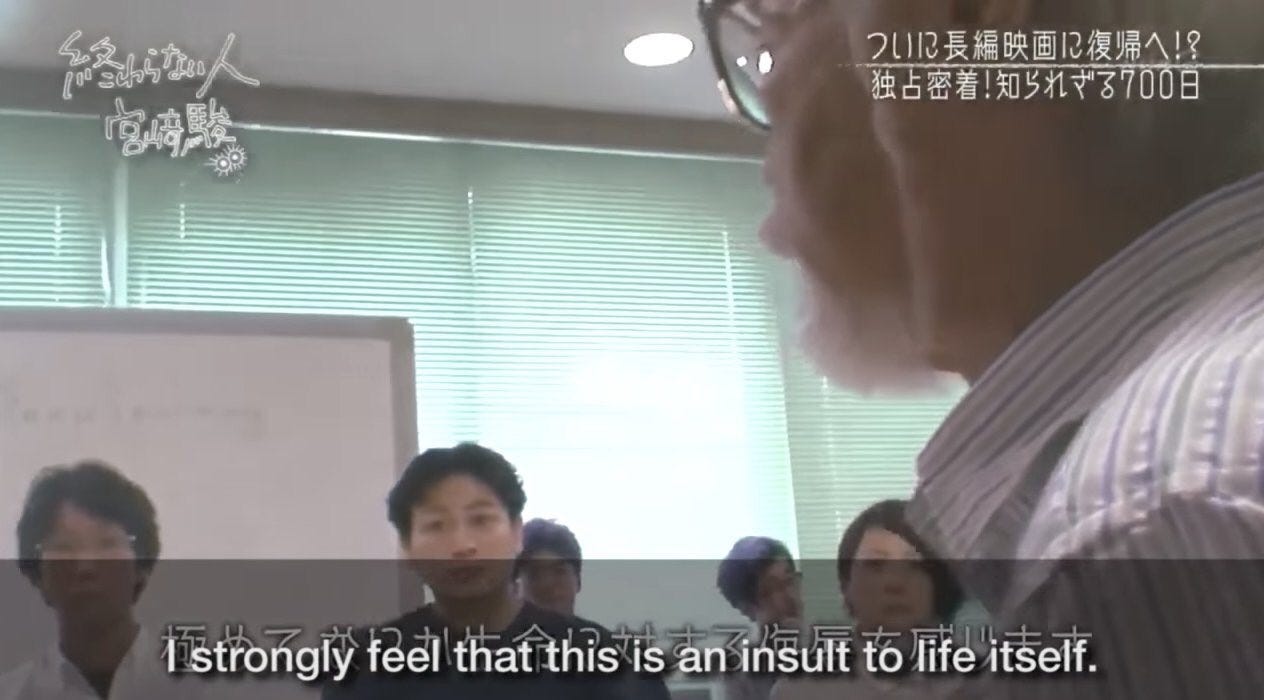
And then, in recent days — or rather, yesterday — I began to see all these images “in the style of Miyazaki.” Almost always, they were followed by Miyazaki’s own disgust for this kind of imagery, the notion that this tool is an insult to life. Here, we’re dealing with the opposite situation from what we discussed earlier. It’s not about an unknown artist being robbed of their art without recognition but rather one of the most important filmmakers of recent decades being literally mocked. It’s not the work of an enthusiast who has spent years learning the language and secrets of an artistic technique in the hope of becoming part of a history of creativity and poetry but the trivialization of the sacred process of storytelling meant to celebrate life through daily effort.
What did I say at the beginning? That I’m not apocalyptic. At least not in this instance. And yet, there are ecological issues, ethical issues, issues tied to the value of work and the value of art. There are people being replaced by tools incapable of performing the tasks they’re supposed to replace, images showing the profound malice of intent of those who use them.
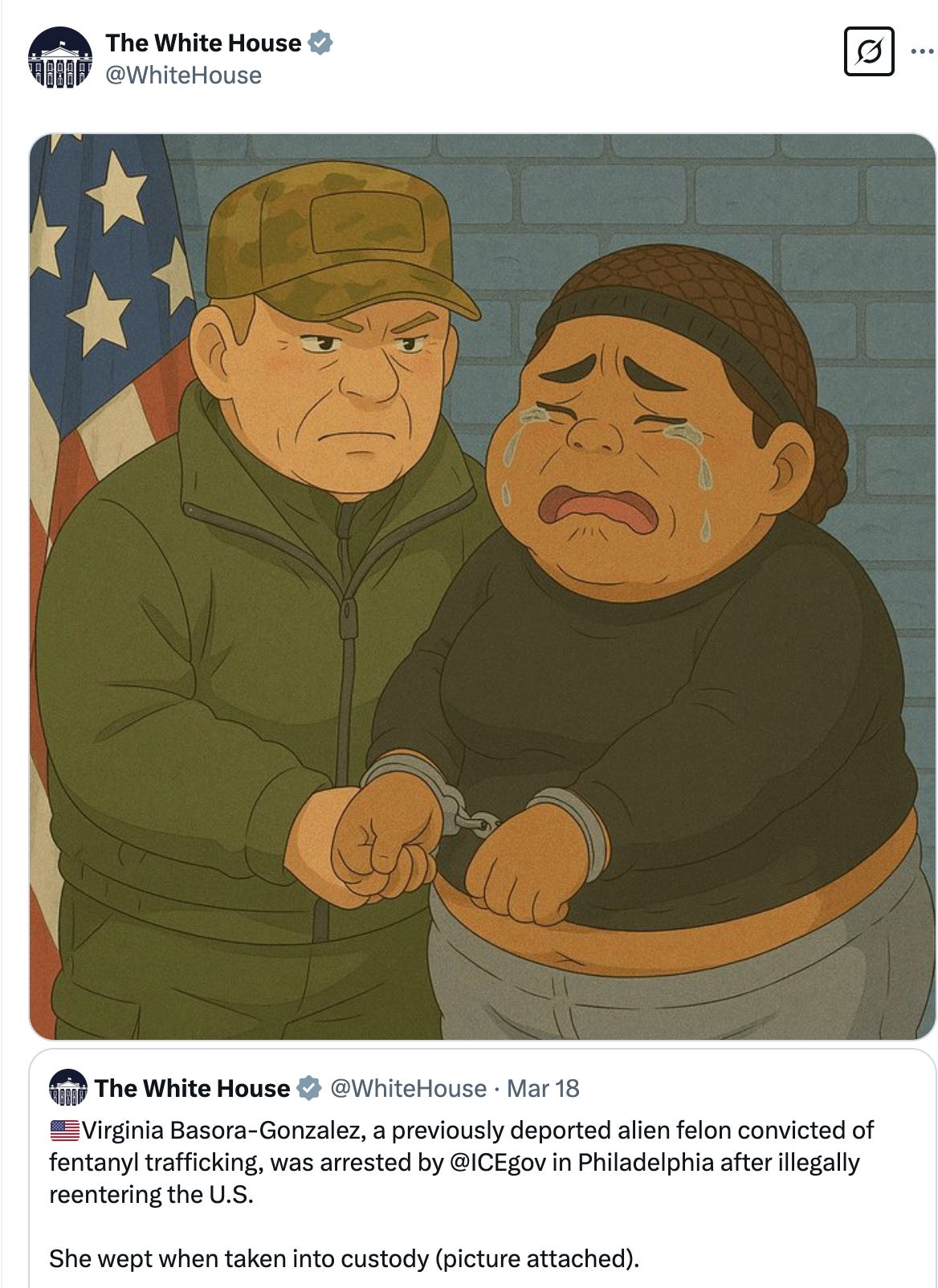
Imagine the disgust of an official government communication channel mocking the imprisonment of a person by altering a photo to imitate the style of an artist who, through his work, tried to give a soul even to the most wicked people, to seek light and goodness even in the most resentful hearts. It has always struck me, for example, that Miyazaki didn’t like the way in which Tolkien’s portraits good and evil in a dichotomy: just think of the differences in their stances on technology and evil, as seen in their stories, such as Saruman’s industrial operations versus the tales of Mononoke and Ashitaka or Nausicaa.
Imagine what a man who opposes the idea of demonizing even a demon or an orc might feel when he sees his art used to mock a handcuffed person by one of the most powerful governments on Earth.
I’ve been wondering a lot whether the future holds a time when reliance on a certain type of technology will become less widespread or if acceleration is inevitable. Will the podcast I’ve been recording for nearly six years, talking about gardens and landscapes, become useless when my voice can be used anywhere? Will we stop making videos and taking photos to prove we’ve been somewhere? Will we develop new ways to verify the validity of a statement or fact? A bit like a Butlerian Jihad. I don’t know.
I still think it has never happened to me to assign any kind of task to one of these tools without having to — and above all wanting to — go back and fix it manually.
Just as I think I would never want to see Trilussa’s “War lullaby” used as fodder to generate poems that mock war victims, and just as I hope people stop using others’ art for moral acts, and just as I hope my voice or image are never used against my consent to affirm things I oppose (or even things I support), I shudder at the certainty that in the coming years, we’ll see every fact, every crime, or event denied on the basis that it’s “AI-generated,” just as they do (and will do) with the genocide carried out by the Israeli army to exterminate the Palestinian people in Gaza.
Lascia un commento